
Skip to content

Turn Technical Advantage Into a Business Case Your Customer Can Use

Revetorque builds custom value-selling and business-case tools for Industrial B2B companies whose products create real operational value — but whose sales teams still struggle to turn that value into a clear, customer-specific commercial case.

We first model the commercial decision. Then we build a dedicated tool to accelerate it.

Technical advantage is not the same as a business case

Your product may use less energy. Reduce downtime. Last longer. Increase throughput. Cut maintenance. Improve process stability.

But your customer rarely buys those advantages in isolation.

They need to understand what those advantages mean for their operation, their costs and their investment decision.

That translation is often where complex Industrial B2B sales get stuck.

An application engineer and a commercial manager review a tablet together beside industrial pumps in a pumping station
  • The seller knows the product.

  • The application engineer knows the technical logic.

  • The customer sees the purchase price.

What is often missing is a credible bridge between them:

Technical performance → operational impact → financial impact → business case

Revetorque helps companies build that bridge into a practical sales tool.

Where does the buying decision get difficult?

Different opportunities get stuck for different reasons.

01

Sell Value Beyond Purchase Price

Your solution may cost more upfront while creating significantly more value over its operating life.

The challenge is making that difference visible before the discussion collapses into a comparison of acquisition prices.

Explore this use case
02

Build an ROI / TCO Business Case

The customer asks:

“What is the payback?”

Now Sales needs more than a generic calculator or a spreadsheet filled with assumptions nobody outside the company understands.

A strong business case must connect real customer inputs, transparent assumptions and product-specific value logic.

Explore this use case
03

Support Internal CAPEX Approval

Winning over your direct contact may only be the beginning.

They may still need to explain the investment to Finance, Procurement, Operations or senior management — often without you in the room.

The commercial case therefore needs to remain understandable and credible after the sales meeting ends.

Explore this use case
04

Productise Expert Sales Knowledge

Some of the most valuable commercial logic in an industrial company lives in experienced salespeople, product specialists and application engineers.

It may exist as spreadsheets, rules of thumb, calculation files or simply years of accumulated judgement.

A dedicated tool can turn that logic into a repeatable workflow that other people can actually use.

Explore this use case

From technical performance to customer-specific economics

Revetorque tools are built around the economics of a specific buying decision.

That can mean connecting variables such as:

  • energy consumption,
  • maintenance cost,
  • downtime,
  • production capacity,
  • labour,
  • consumables,
  • waste,
  • expected lifetime,
  • replacement frequency,
  • financing assumptions,
  • or other application-specific value drivers.

The purpose is not to generate an impressive-looking ROI number.

The purpose is to make the commercial logic visible, transparent and usable.

A well-designed tool shows where the value comes from, which assumptions matter and how the result changes when the customer's situation changes.

  1. 01

    Technical input

    Product performance, application data and customer operating conditions.

  2. 02

    Operational impact

    What changes in the customer's real process or operation.

  3. 03

    Economic impact

    What those changes mean financially.

  4. 04

    Decision output

    A business case the seller and customer can actually work with.

Dedicated tools for the decision your sales team needs to move forward

Revetorque is not limited to one type of calculator or one predefined software template.

We build tools around the commercial decision that needs to be made.

Depending on the use case, that may include:

Module 01

Business Case Tools

Turn technical and commercial inputs into a structured investment case that can be discussed with different stakeholders.

Module 02

ROI & TCO Tools

Model payback, lifecycle cost and other economic comparisons using customer-specific assumptions.

Module 03

Guided Selling Tools

Help sales teams structure complex discovery, qualification or solution selection using expert logic built into the workflow.

These are examples — not fixed packages.

The tool should follow the decision logic, not force the decision into a generic template.

Explore Solutions

Revetorque is not for every B2B sales team

The strongest use cases usually share three characteristics.

  1. 01

    The product creates measurable operational value

    Its advantage can influence costs, productivity, reliability, resource consumption, risk or another economically meaningful outcome.

  2. 02

    The buying decision is complex

    Several technical and commercial variables influence whether the investment makes sense.

  3. 03

    The situation repeats

    Salespeople regularly face similar customer questions, calculations, comparisons or decision processes.

If your product is bought primarily on unit price, the economics cannot be meaningfully modelled, or every deal follows completely different logic, a dedicated value-selling tool may not be the right solution.

That is something we would rather establish early.

Built specifically for complex Industrial B2B sales.

See who Revetorque is built for

See what the logic looks like in a working tool

A value-selling tool should be easier to understand when you can see it working.

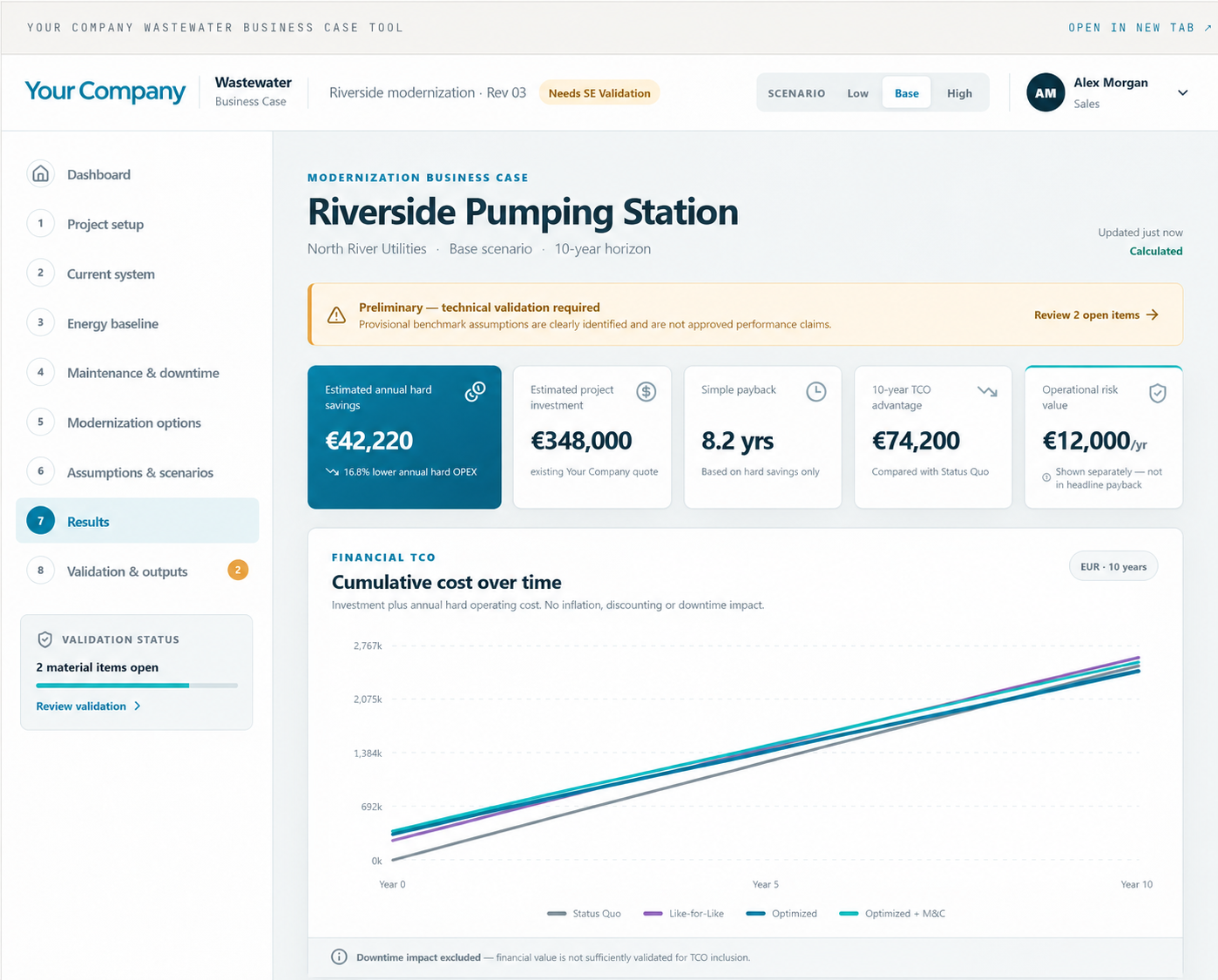
Our examples show how different industrial sales problems can be translated into usable digital workflows — without exposing confidential customer information.

Each example focuses on five things:

Illustrative interface structure
Working business-case tool screen: project steps, scenario selector, validation notice, key financial results and a cumulative cost-over-time chart
  1. 01

    The sales problem

    What decision or commercial friction the tool was designed to address.

  2. 02

    The inputs

    What the salesperson or customer needs to know.

  3. 03

    The value logic

    How technical and operational variables are connected to the commercial model.

  4. 04

    The output

    What the tool gives the user to support the next step in the buying process.

  5. 05

    The user

    Who the tool was designed to help — Sales, a technical specialist, a customer champion or another stakeholder.

Examples may include tools created for sectors such as industrial equipment, pumps, compressed air, process technologies and other complex B2B applications.

See Working Examples

Start with the commercial decision. Build the software second.

A good-looking interface cannot fix a weak value model.

That is why Revetorque does not start by asking what kind of app you want.

We start by understanding the decision the tool needs to help move forward.

  1. 1.Define the use case

    Where does the sales process become difficult, inconsistent or unnecessarily dependent on expert intervention?

  2. 2.Model the decision

    What does the customer need to understand or calculate before they can move forward?

  3. 3.Validate the logic

    We structure the required inputs, assumptions, calculations and technical dependencies before they are buried inside software.

  4. 4.Build the dedicated tool

    The validated logic becomes a practical workflow designed around the people who will actually use it.

  5. 5.Put it into real sales situations

    The tool can then be tested against real opportunities, real users and real customer questions.

We first model the commercial decision. Then we build a dedicated tool to accelerate it.

See How It Works

Have a real use case in mind?

You do not need a finished specification.

A useful starting point is usually much simpler:

  • a recurring sales problem,
  • a spreadsheet your team already uses,
  • a business-case calculation that takes too much manual work,
  • a product whose economic value is difficult to communicate,
  • or a decision process that currently depends too heavily on a few experts.

Bring us the problem.

We will help determine whether it makes sense to turn it into a dedicated tool.

Discuss a Use Case

Tell us what your team is trying to sell, where the decision gets difficult and how you handle it today.

Discuss a Use Case